From RCT to real-world impact: How our Accelerator is adapting the evidence on immunization demand in Nigeria
Evidence Action
/
Vaccines are one of global health’s greatest success stories, preventing 146 million child deaths since 19741 and generating $52 for every dollar invested2. Major advances in vaccine supply, cold chain infrastructure, and delivery systems have brought lifesaving immunizations within reach of most of the world’s children.
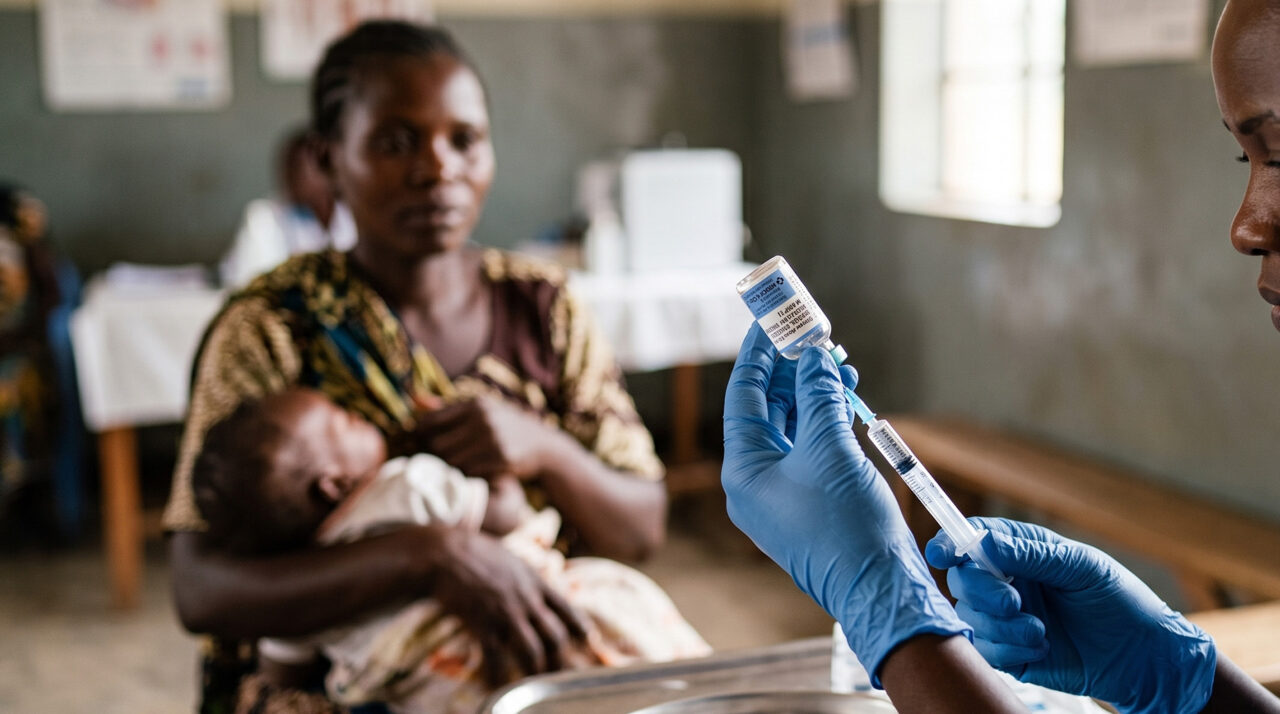
Yet 20 million children remain unvaccinated or undervaccinated today3, of which 14.5 million children never receive a single vaccine dose4. So what’s missing? In many places, the answer is demand — and not because of opposition to vaccines.
The audio clips throughout this piece are drawn from a recent Evidence Workshop, where researchers and practitioners gathered to discuss the evidence base for immunization demand generation and how it is being adapted for real-world scale. These snippets capture key moments from that discussion.
A lot of the effort had been focused on making supply as close as possible, as good as possible… which, as you fill in more and more of the gaps, becomes more and more expensive. So that’s a place where a lot of effort had been going, and maybe reaching a plateau in terms of effectiveness.
We’re really not in a world where people are very skeptical. We’re in a world where people generally are perfectly fine. They think immunization is a good idea when you ask them.
Caregivers forget when the next dose is due. They don’t know their child is behind schedule. The clinic is a long motorbike ride away, and the trip competes with a day’s work. They intend to go but don’t get around to it.
These are informational and motivational barriers, and a growing body of evidence suggests they can be addressed with surprisingly simple tools: a well-timed text message, a conversation with a community member, a small financial nudge.
The evidence: what a massive trial in India revealed
In Haryana, India, a team of researchers led by Nobel laureate Esther Duflo and network theory expert Arun Chandrasekhar — both Abdul Latif Jameel Poverty Action Lab (J-PAL) affiliates — ran one of the largest and most complex randomized controlled trials ever conducted on immunization demand. The study spanned more than 900 villages and 295,000 children, testing 75 combinations of three interventions: SMS reminders, community ambassadors, and small financial incentives.
The most striking finding from the research isn’t any single intervention; it’s that delivering demand-side tools as an integrated package produced results that no component achieved alone.
Most cost-effective
Reminders + ambassadors
+26%
Most effective
Reminders + ambassadors + incentives
+44%
26% increase in full immunization (~1.9 more children completed the schedule per village per month). Increased immunizations per dollar by 9.1% — less expensive per immunized child than the status quo program.
One that increases vaccination less, but costs much less money, because it doesn’t involve giving incentives, is to combine community ambassadors and SMS reminders. This package increases vaccination coverage by 26% compared to doing nothing. It costs almost nothing. It is the most cost-effective — in fact, it’s the only thing that’s more cost-effective than just continuing with the status quo.
44% increase in full immunization (~4 more children per village per month). In the lowest-coverage areas, this package increased immunization rates approximately six-fold.
In places where immunization is low to start with, the effect is the largest. So that’s great, because that means it’s also very cheap, because in the absence of the incentive, no one gets immunized, so you don’t have very many infra-marginal children. So the cost per extra immunization gets lower. It’s not only effective, but also cost-effective. But you really have to target. Any system should just implement ambassadors and SMS everywhere, and then they should identify pockets where coverage is very low, and then go all out there with incentives.
The research also revealed something critical about who makes an effective ambassador: the key is finding people who happen to have connections across a community’s sub-groups — across caste lines, across neighborhoods, across social circles — so that information flows through them naturally. These are not necessarily the most trusted or most senior people.
Our inclination from a policy perspective often is to say, well, we have a good handle on the leadership in a community, so maybe the governing body, or the health authorities, and we should use them to stimulate demand for immunization. That’s interesting, because it actually requires a lot of effort on the part of the leaders. They need to, in some sense, go to each of these sub-communities and push them. So it’s not exactly automatic that they’d be great.
What you would want instead is somebody who happens to have just a few contacts in each sub-community. We might call them a gossip, but we can rebrand them as information ambassadors in a more dignified way. We want somebody who’s able to talk to all of the communities.
Further reading
Two papers, one study ecosystem
These papers contribute to the evidence base behind immunization demand generation. Click to expand each for a brief summary.
Selecting the Most Effective Nudge: Evidence from a Large-Scale Experiment on Immunization
Banerjee, Chandrasekhar, Duflo et al. · Econometrica, 2025
+
The primary paper from the Haryana study. Researchers cross-randomized three interventions — incentives, SMS reminders, and community ambassadors — across 140 primary health centers and 755 subcenters serving ~295,000 children. This produced 75 unique treatment combinations.
Rather than reporting results for each combination individually, the authors developed a machine-learning method (Treatment Variant Aggregation) to identify which packages were most effective and most cost-effective.
Using Gossips to Spread Information: Theory and Evidence from Two Randomized Controlled Trials
Banerjee, Chandrasekhar, Duflo & Jackson · Review of Economic Studies, 2019
+
This paper establishes the theoretical and empirical foundation for the ambassador component. In two experiments — 213 villages in Karnataka and 521 villages in Haryana — researchers tested whether community-nominated "gossips" could spread information more effectively than randomly selected individuals, influential leaders, or trusted advisors.
The key finding: simply asking a few villagers who is good at spreading information was an easy, inexpensive, and reliable way to identify network-central individuals who then drove meaningful behavior change. In Haryana, villages with information hub ambassadors saw 22% more children vaccinated monthly.
How immunization demand generation is advancing through our Accelerator
Our Accelerator is a six-stage decision-focused process designed to find, vet and scale only the most cost-effective, evidence-based interventions: Only about 2–3% of interventions we review proceed through the full pipeline, from desk research to programs that measurably improve millions of lives.
The Haryana research flagged immunization demand generation as an Accelerator candidate, and the intervention has advanced through multiple stages since.
The rich immunization demand literature base, including the Haryana trial described above, met that bar immediately, and a single day of review moved the intervention forward.
The evidence was strong and the early cost-effectiveness estimates compared favorably against Evidence Action’s stringent thresholds.
For each intervention in the package, our team examined the full evidence base across countries and contexts, stress-tested key assumptions, and refined the cost-effectiveness model. Where the evidence was strong, we built on it. Where it was context-dependent, we flagged what would need to be tested in Nigeria.
In addition to assessing the primary criteria — evidence, cost-effectiveness, and scale — we moved into a deeper assessment of secondary and tertiary factors that determine whether an intervention can realistically succeed: the policy environment, government readiness, operational feasibility, and whether existing systems can support delivery.
Through successive rounds of geographic assessment, Nigeria emerged as a particularly strong fit across all criteria.
Evidence
Nigeria has its own growing evidence base on these interventions, including academic trials and results from implementing organizations that have run elements of the package in the Nigerian context. UNICEF data from 2021 confirms the demand-side fit: roughly half of caregivers who miss vaccine doses cite awareness gaps and scheduling confusion5. Our own operational experience also reinforces the case: qualitative research from a recent antenatal care pilot in Nigeria found that 83% of health workers identified SMS reminders as an effective tool for improving adherence, signaling that digital messaging can work within Nigeria’s existing health infrastructure.
Cost-Effectiveness
Early modeling, drawing on the Haryana trial’s effect sizes adjusted for Nigeria’s baseline vaccination rates, estimates the intervention is cost-effective at $128–$247 per disability-adjusted life year (DALY) averted. The range reflects different intervention packages and scenarios, and we expect these figures to sharpen considerably as the pilot generates actual cost and coverage data from the Nigerian context.
Scale
Nigeria has 2.1 million zero-dose children — 15% of the global burden — with close to 9 million undervaccinated. The infrastructure to reach the target population at scale already exists: mobile phone penetration in target states is close to 90%.
It is well documented in Nigeria that vaccines are widely available. Availability of vaccines, supply was definitely not a problem. The addressable barriers have actually been informational and motivational. This creates a unique opportunity for cost-effectiveness and impact at scale. Amongst the high-burden states in Nigeria, Evidence Action currently covers approximately 50% of those states, and we have boots on the ground really supporting the government to roll out all of these interventions.
To ensure regional diversity is accounted for in pilot learnings, Evidence Action intends to pilot the intervention across two states — one in the North Central region, one in the South West.
J-PAL researchers are supporting Evidence Action to design a rigorous pilot and monitoring approach that ensures fidelity to the evidence while also allowing for contextual adaptation and testing in Nigeria.
If the pilot data confirms feasibility and cost-effectiveness, we’ll consider launching across additional Nigerian states with the goal of reaching more than one million children.
The final stage tests whether the model holds at full scale — not just operationally, but in terms of government integration and handover. This is where we work to transition from an Evidence Action-supported program to one that is fully government-owned, while also assessing whether the model can be adapted for other high-burden countries.
Adapting the evidence for pilot in Nigeria
Advancing to a pilot does not mean replicating the trial. Our focus is on adapting rigorous research to the Nigerian context, developing and testing a model that could eventually be fully government-owned and replicable across geographies.
What we hope to accomplish from this pilot and from this adaptation work is that by the end, we will have collaborated with government to develop a model that is suitable and impactful for the Nigerian context, able to be a fully owned government program, and has the ability to scale widely.
Here are five ways we’re doing that.
Before designing anything new, we needed to understand what had already been tested. Nigeria has a rich and growing evidence base on these interventions, which will be incorporated into our initial program design. This is core to our Accelerator model: we don’t start from a blank slate, and we don’t assume that evidence generated in one country automatically applies in another.
The Haryana trial tells us that reminders are effective in combination with other interventions. It doesn’t tell us whether caregivers in Nasarawa prefer WhatsApp to SMS, whether voice messages perform better in communities with lower literacy rates, or what time of day a reminder feels helpful rather than intrusive.
Over the coming months, our team will be engaging with caregivers and healthcare workers in focus group discussions, surveys, and conversations to gain a deeper understanding of topics that will inform program design. The formative research will tell us which framings are plausible and culturally appropriate; the pilot will show us which ones actually move behavior.
For these interventions, small tweaks to design can lead to large changes in realized impact. The Haryana researchers demonstrated this at massive scale: each of the 75 variations of package compositions produced measurably different outcomes.
With J-PAL’s support, we will be randomly varying small aspects of the program design such as the density of ambassadors (would three per community be sufficient, or would five be more effective?), the profile of ambassadors (caregivers nominated by their peers versus religious or community leaders), and the content, timing, and quantity of reminder messages. We will then work with J-PAL and associated researchers to leverage machine learning techniques and compare and rank the effectiveness of each of these models. We will also employ a rigorous baseline and endline data collection exercise to track the overarching impact of our pilot across different variations.
The Haryana research showed that type and targeting of incentives matters at least as much as whether to offer them at all. We’ll be testing two incentive models designed for the local context:
🥜 Nutrition Supplement: Does a tangible health product feel valuable to caregivers? Ongoing research from the Nigerian context shows that small-quantity lipid nutrient supplements (SQ-LNS), a peanut butter-like paste, may work as a highly effective incentive when linked to immunizations.
🎟️ Transportation Offsets: Is the cost of travel a binding constraint for caregivers? Distance to clinics is a commonly cited barrier to vaccination in Nigeria. We’ll test whether a more traditional small offset to cover transport addresses a real cost that competes with a day’s income.
Testing these two models lets us learn not just whether incentives work in Nigeria, but which kind is most motivating, most logistically feasible, and most compatible with eventual government ownership.
Evidence Action’s model is to build programs that work through the systems governments already run. For this pilot, that means designing the program to fit within Nigeria’s existing immunization infrastructure rather than creating parallel systems.
Testing across two states with different administrative contexts lets us surface what state-level ministries and health boards need to sustain the model with their own resources and optimize towards a model that would lead to eventual government adoption.
Government ownership and scalability: this is something that we’ll be trying to incorporate and iterate on across the pilot. Things like data source integration, integration with existing government systems. An example I’d call out is the malnutrition product. That is a government-run and owned program that Evidence Action is assisting with, but it’s being rolled out with existing systems, trainings, and budgets in place. So utilizing something like that as the incentive does offer huge advantages in terms of ownership and scalability versus trying to set up entirely new systems.
What's next?
We are currently beginning formative research, with the goal of launching pilot activities and enrollments by the end of 2026. Between now and then, every one of these adaptation areas will be refined based on what we learn from caregivers, health workers, and government partners on the ground.
A trial tells you that something works, but a pilot tells you whether you can make it work in a specific place, through a specific system, and for a specific population. Even with compelling evidence, many health interventions fall short of their potential because few organizations can scale them effectively and affordably across diverse settings. Our Accelerator exists to bridge that distance — turning what researchers prove into what governments can actually deliver.
Something I’m hoping some of the work with Evidence Action will lead us to is asking and answering: how do we build a playbook for what works where? That’s a thing we haven’t actually really talked about, and that represents a slightly different problem, but an important one.