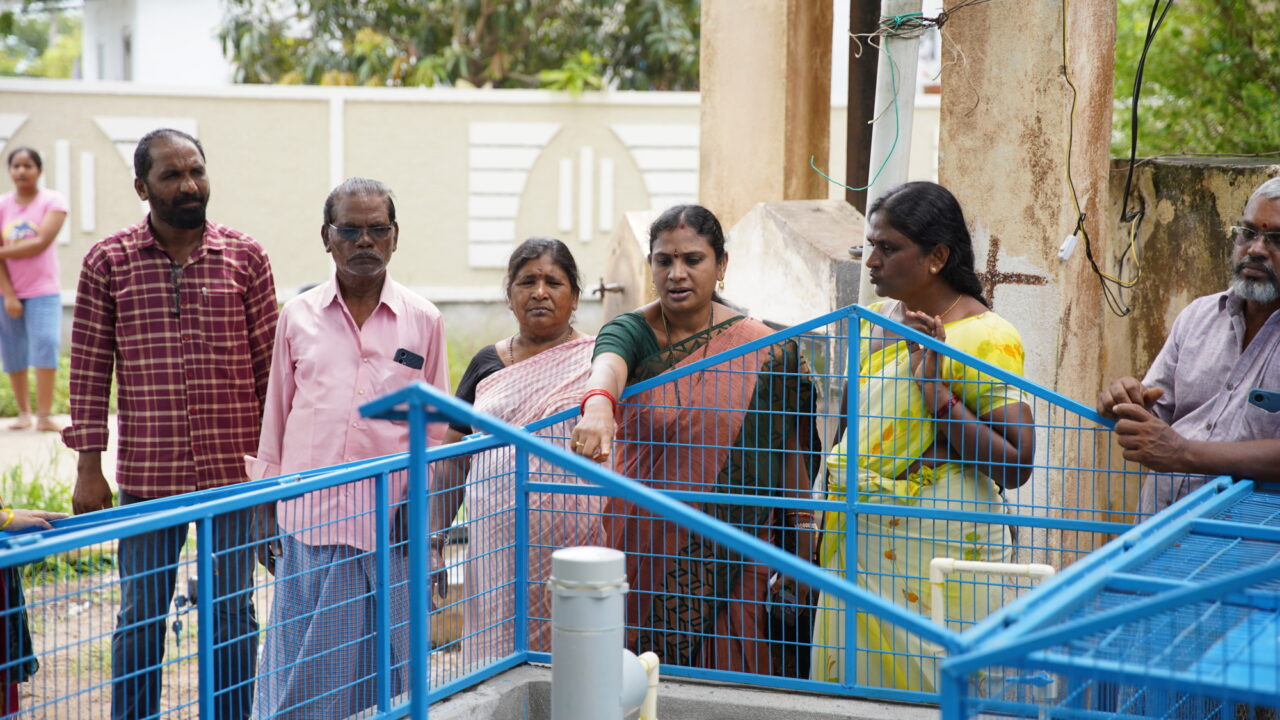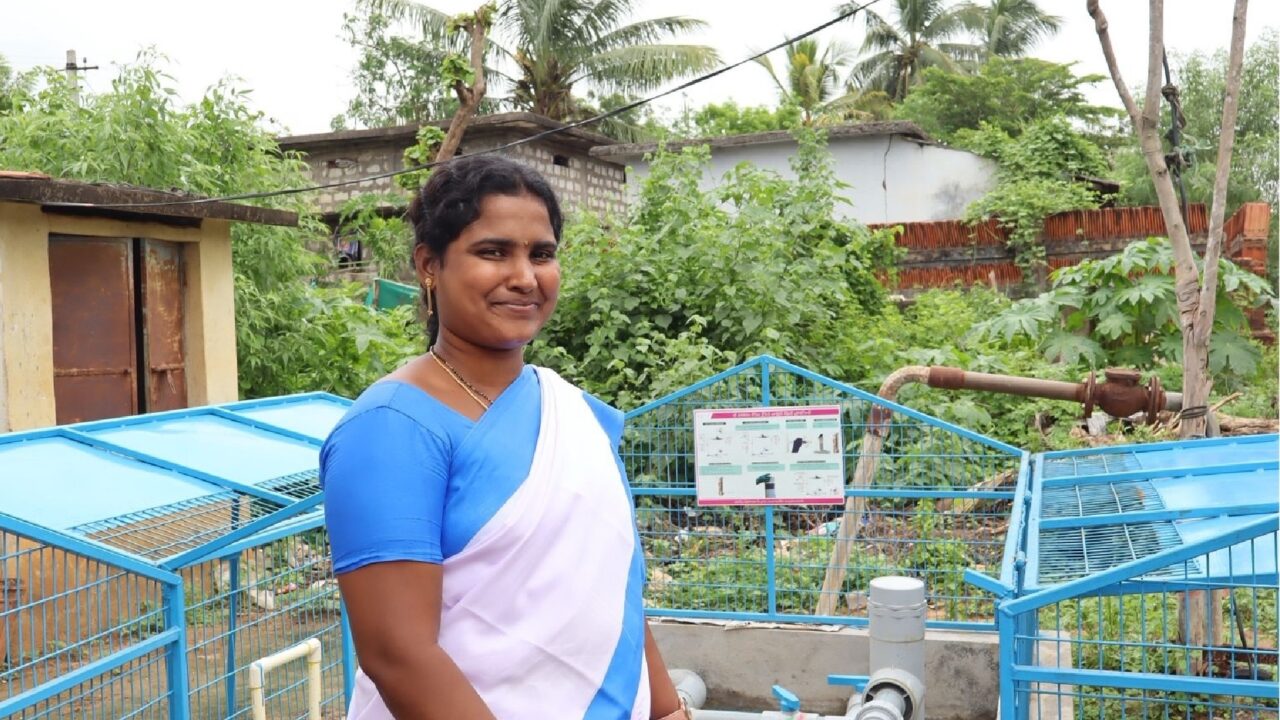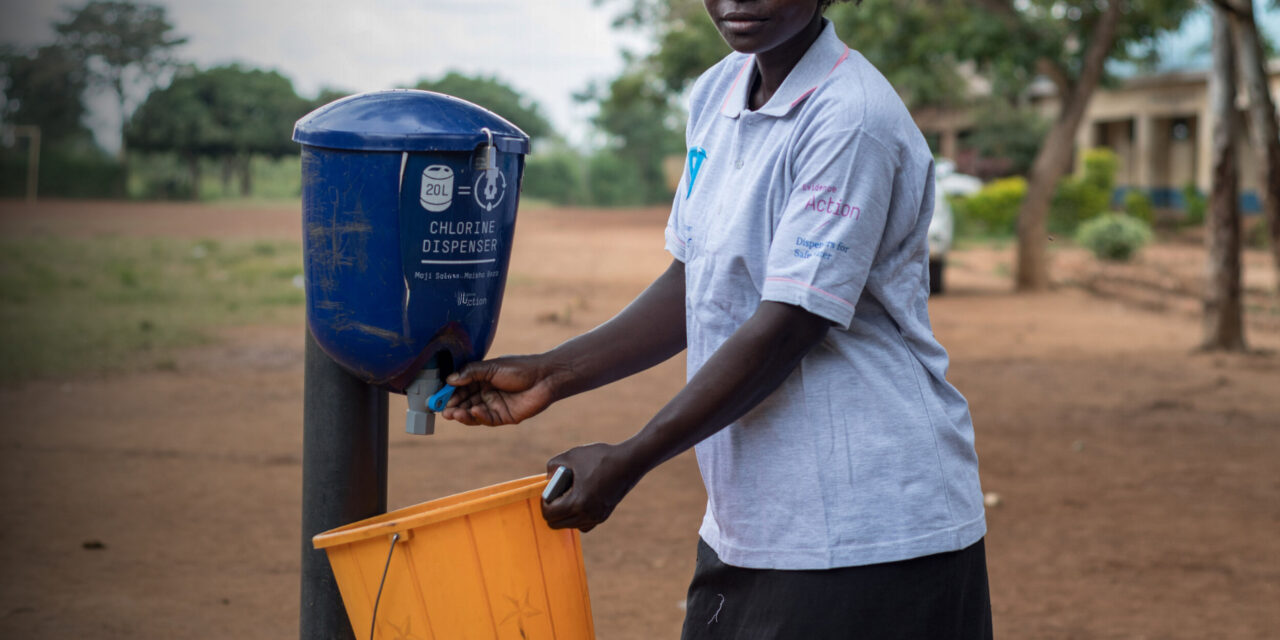
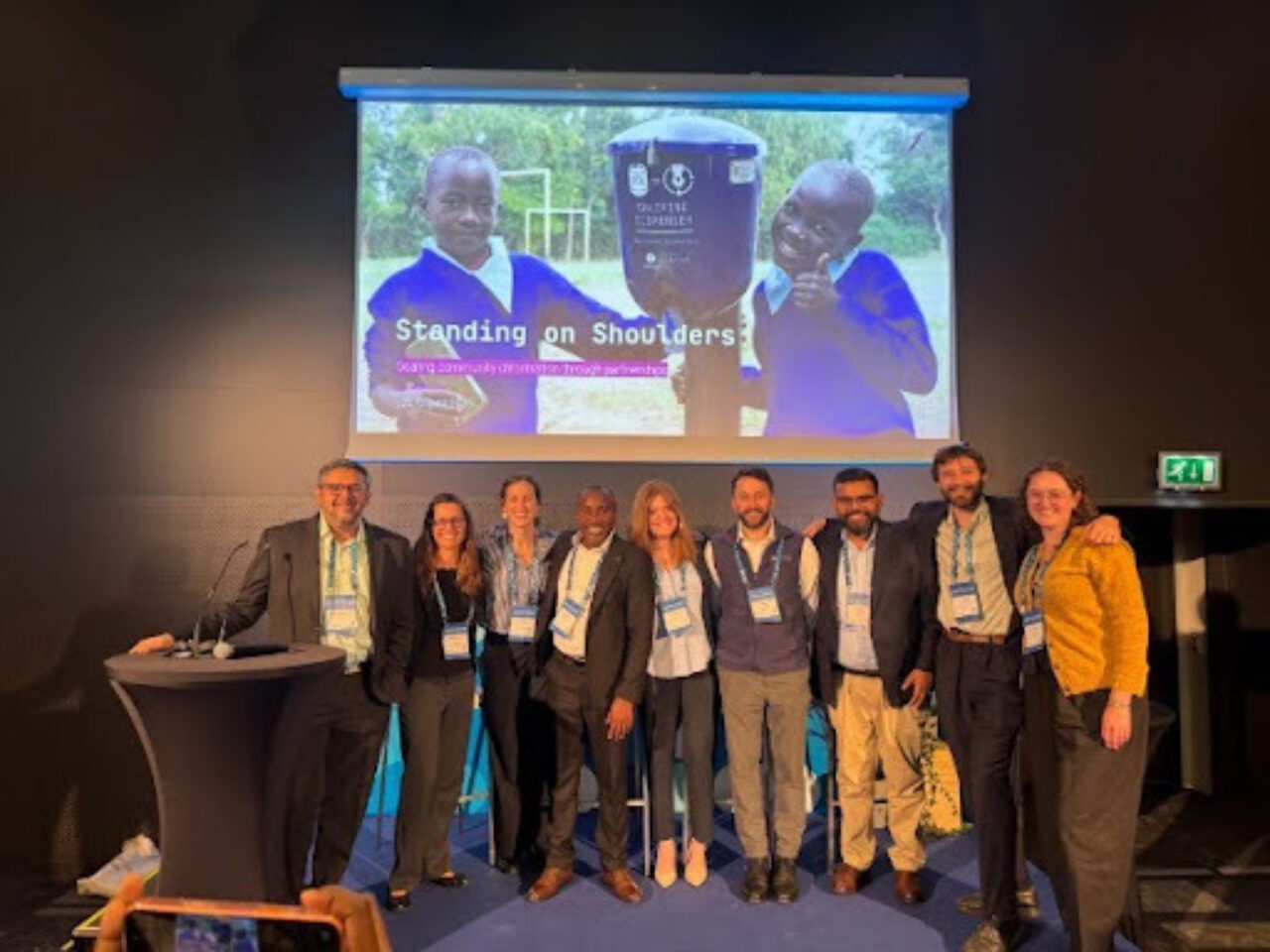
We spent this year’s World Water Week doing something new: convening a panel around community-based chlorination and inviting our closest partners to join. We (modestly) called it “Standing on Shoulders,” after Isaac Newton’s line: “If I have seen further, it is by standing on the shoulders of giants.”1 The shoulders here are more than a decade of running chlorine dispensers: more than 50,000 at their peak across Malawi, Kenya, and Uganda, providing nearly eight million people in rural communities with the choice to treat their water.
After years as the black sheep of a water sector that, with limited resources, has prioritized access to water over its safety, chlorination is drawing more interest than we can remember. Much of the credit for that is due to GiveWell’s investments and tighter carbon financing rules that now require proof that water is actually safe when people drink it.
The timing of this new interest is not lost on us. Chlorination is gaining momentum at a moment that has been hard for our own safe water program. After learning that our monitoring had systematically overestimated how many people were treating their water, we chose to narrow our footprint to the geographies where we are most cost-effective. That decision meant saying goodbye to staff who together gave over 1,000 years to this work, and to some communities we have served for a decade.
Chlorination itself is not in question, and it remains among the most cost-effective ways to keep children alive past their fifth birthday. Professor Michael Kremer and his team at the Development Innovation Lab estimate that water treatment reduces the odds of a child dying before age five by roughly 20%. We know that water needs to be treated to be safe to drink. The challenge has always been getting chlorination into daily use, and knowing whether you have.
So, we’re sharing our playbook, and the partners who joined us on stage at World Water Week are the ones testing it.
With GiveWell’s support, four organizations are launching dispenser pilots in Nigeria and Ethiopia, and Megan Morris, senior program officer at GiveWell, opened the session by setting out what they hope to learn. Beyond hardware and supply chain setup, we’re sharing over a decade of operational knowledge, failures included. Our hope is that they can leapfrog (our word for 2026) what we learned, improve the model, and share what they find.
What they’re testing
Impact Water chose Katsina State, where they already have water treatment systems in around 3,000 public schools, and co-designed the pilot with the state government before selecting Mani LGA — 1,000 dispensers, an expected reach of roughly 300,000 people. Their CEO, Mark Huelsenbeck, took our model and asked which dials were worth “turning up.”
Our promoters have historically been elected community volunteers (this is changing!). Impact Water’s promoters will be paid a stipend. They were recruited over six months with the rigor of a senior hire: nominated by community leaders, then interviewed and scored. One criterion ruled out many strong candidates: being at the dispenser three times a week, because Mark believes persuasion has to happen at the water point. Above the promoters sits a layer we never had: a full-time field agent for every 40 promoters. And because our experience shows that children are often the ones turning the dispenser valve, those agents also spend two days a month in schools.
Dimagi is testing a different thesis. Its Connect platform, built on 20 years of work with frontline health workers, pairs locally led organizations doing the implementation with digital tools doing the verification. Around 500 dispensers to start, in two Nigerian states. The pilot starts with around 500 dispensers in two Nigerian states. Circuit riders from local organizations will visit each dispenser about every 15 days, and each visit is verified with photos, GPS, and timestamps. They’ll be able to leverage the existing work of people closest to the work, and keep their own team lean.
Sagar Atre, Technical Project Manager at Dimagi, named two surprises. The first was how much contextual judgment the local organizations brought — to water point selection, to negotiating with local agencies, to sequencing the work. The second came from the water point census. In cholera-endemic wards, communities already knew about chlorine. They just couldn’t reliably get it, and when they could, it cost too much.
Catholic Relief Services is installing dispensers in Tigray, Ethiopia, building on a previous pilot we did together with the Millennium Water Alliance. They’re testing a service delivery model that integrates chlorine supply into government systems, supports maintenance through local enterprises, and builds in stronger user feedback to improve adoption over time. Self Help Africa is piloting in Kano, Nigeria, bundling chlorine supply with water point maintenance. We’re excited to learn whether improving the functionality of water systems encourages more people to use the dispenser.
Each partner is working with a local monitoring and evaluation firm to collect independent baseline and endline data, which was one of the key learnings from our own monitoring review. In Stockholm, Rachel Peletz, executive director of the Aquaya Institute, outlined Aquaya’s role in three areas. The first is keeping external data comparable across pilots. The second is building capacity, since several firms had never run a chlorine residual or E. coli test. The third is letting protocols adapt to context without quietly undermining comparability. Baselines are underway.
The word none of us wanted to use
Our favorite audience question from the panel: is there a better word than failure for something well researched and well designed that didn’t deliver the result you wanted?
Sagar’s answer was that at Dimagi, the first phase of any implementation is a “trial run,” a built-in acknowledgment that a program isn’t finished on launch day. Some of their trial runs took two or three years and hundreds of thousands of field visits before the team called them ready to scale.
For Mark, failure has the same definition as insanity: doing the same thing over and over and expecting different results. He told the room that by working from our documentation and our mistakes, his team skipped perhaps five years of iteration.
Moses answered differently. “We have all taken exams,” he said. “I don’t believe every student scores 100%.” What matters is what we do next, because no one should be dying from diarrhea in 2026.
Anna’s answer: failure is knowing we could be more effective and not doing everything we can to improve.
Arthur Baker of the Development Innovation Lab, whose team helped collect the data that surfaced the problem, was more generous than we could have been. By almost any standard in the sector, he said, the program remained cost-effective and was not a failure. It fell short of GiveWell’s bar and our own, which are among the most demanding anywhere. “I would say B plus,” he said. “But the answer is we need an A.”
We’re committed to sharing everything we can to help our partners get to an A.