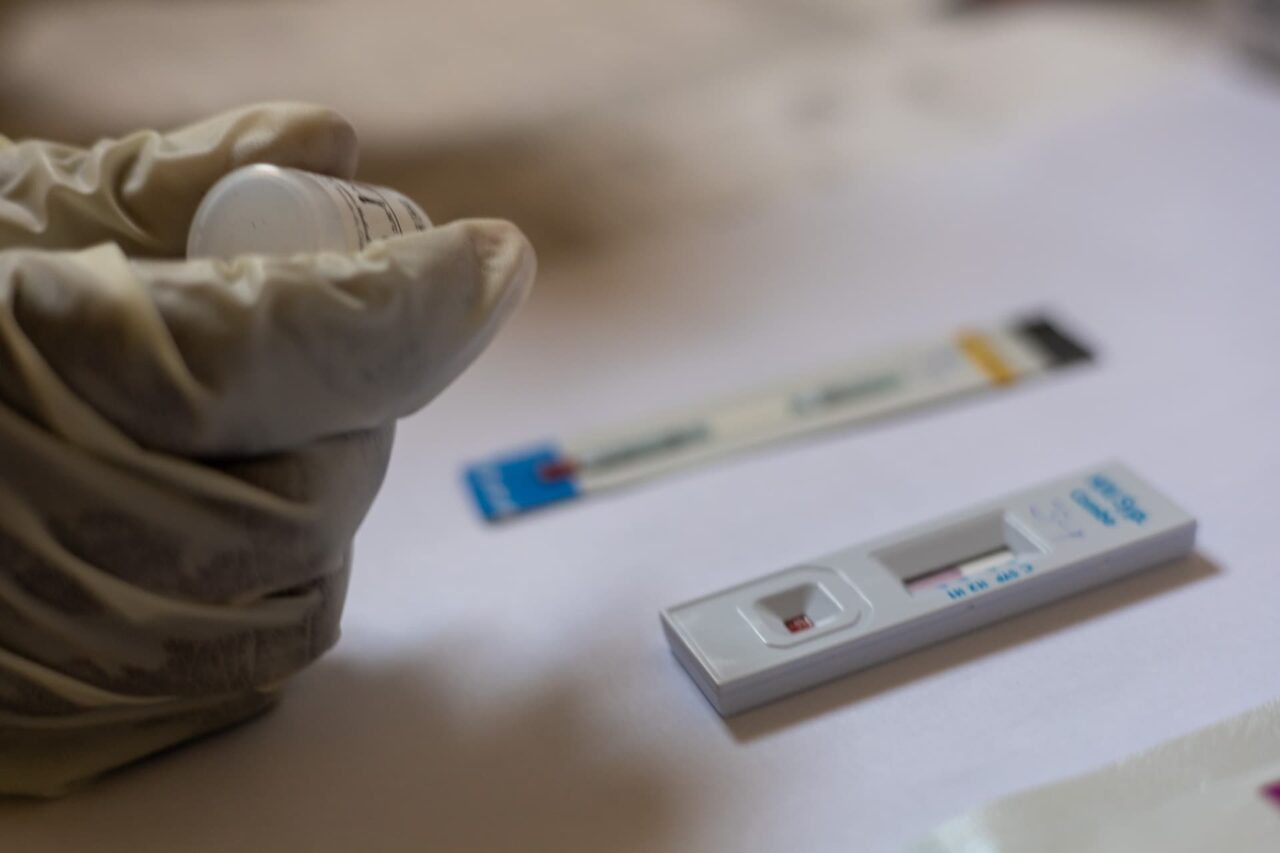
Right now, governments across the world are drafting the funding applications that will shape their health systems through 2029. The Global Fund's Grant Cycle 8 (GC8) represents a critical window: decisions made in the coming months will determine whether millions of pregnant women gain access to syphilis screening and treatment — or whether the gap persists for another full funding cycle.
To support this process, Evidence Action has published a GC8 Syphilis Toolkit, a set of resources designed to help country teams, technical assistance partners, and Country Coordinating Mechanisms integrate dual HIV/syphilis rapid tests and benzathine penicillin G (BPG) into their GC8 funding proposals.
The toolkit includes:
- A syphilis integration checklist that maps the full GC8 application timeline, from country dialogue through pre-submission review, with syphilis-specific actions at each stage.
- A quantification and budget calculator, an Excel-based tool that generates three-year procurement quantities, landed cost budgets, and funding scenario analyses for dual tests and BPG.
- An impact evidence package with proposal-ready narrative language, cost-effectiveness evidence, and citations formatted for GC8 applications.
- A one-page evidence brief for use in CCM meetings, Ministry of Health discussions, and stakeholder planning sessions.
The toolkit was shared during a webinar co-organized by the World Hepatitis Alliance, Evidence Action, Clinton Health Access Initiative, PATH, and Unitaid. The session brought together over 185 country stakeholders and partners to discuss the policy landscape, application guidance, and practical tools now available.
Companion resources from partners
These toolkits have been developed in coordination with Evidence Action's GC8 Syphilis Toolkit. Together, they cover the full scope of triple elimination planning — from syphilis integration and triple testing product selection to primary health care integration readiness.
GC8 Integration Toolkit
Practical guidance for integrating hepatitis, harm reduction, and triple elimination into HIV programs.

EVT Integration Toolkit for GC8
A three-part toolkit for positioning elimination of vertical transmission within GC8 applications.

Integration Primer & RAPID Tool
Pragmatic guidance for advancing integrated systems and services across primary health care.
Why this moment matters
Congenital syphilis — where an infected mother passes syphilis to her baby during pregnancy — causes over 390,000 adverse birth outcomes each year, including 150,000 stillbirths and 70,000 neonatal deaths. The burden is worsening: babies born today are 11% more likely to be exposed to congenital syphilis than eight years ago.
Nearly 70% of these adverse outcomes occur among women who are already inside the health system — they attended prenatal care but were either never tested for syphilis or tested positive and never adequately treated.
The solution is remarkably cost-effective. A dual HIV/syphilis rapid test replaces the single HIV test already in use in most prenatal care settings, adding syphilis detection for just cents more per test using the same health worker and the same finger-prick procedure. For women who test positive, a single injection of benzathine penicillin prevents the vast majority of adverse outcomes.
The GC8 HIV prioritization guidance explicitly endorses dual HIV/syphilis tests as the first-line prenatal test. But policy endorsement alone does not guarantee that syphilis makes it into a country's funding request. The application process requires specific outputs — commodity quantities, cost documentation, narrative justifications — that many country teams have not had to prepare for syphilis before. These tools were built to close that gap.
About Syphilis-Free Start
Evidence Action's Syphilis-Free Start program provides technical assistance to governments to scale dual HIV/syphilis testing and strengthen syphilis treatment provision during prenatal care.

National coverage of syphilis testing in pregnancy has grown from 8% to 79%*, and 94% of women testing positive now receive treatment. Four of the country's fifteen counties have already graduated to full government ownership, and the rest are preparing to transition.

Syphilis screening at trained facilities has doubled from 45% to 90%, with 90% of women testing positive now receiving same-day treatment. The program reaches facilities serving roughly 85% of Zambia's pregnant women, and a 2025 survey revealed that syphilis prevalence is more than double previous national estimates — underscoring the scale of the opportunity.

The Ministry of Public Health has led a rapid expansion of dual HIV/syphilis testing, with national data systems now capturing results in real time — enabling the Ministry to plan expansion to 1,000 additional facilities with support from Global Fund, PEPFAR and other partners.

This year, we’re bringing Syphilis-Free Start to Côte d’Ivoire, where we expect to reach 3.6 million pregnant women and prevent more than 17,000 adverse birth outcomes over the next five years.
*An earlier version of this announcement reported that 88% of pregnant women attending antenatal care in Liberia were screened for syphilis in 2024. We have since revised that estimate to 79%. In 2024, we did not have enough survey data to use our preferred estimation method, so we relied on a less precise approach. With more complete data in 2025, we applied the preferred method and found that it gives a 2024 figure of 79%. This reflects a more accurate estimate, not a decline in screening.